
THE LONG WALK Review — A Different Type of Horror
Lisa Johnson Mandell’s The Long Walk review reveals why and how this multi-genre thriller ranks right up there with Steven King’s very best film adaptations.
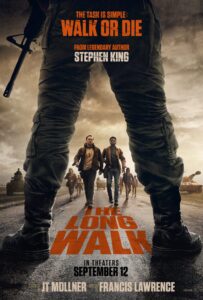 The title doesn’t exactly send you madly scrolling through your favorite movie ticket app, intent on scoring the best seats in your favorite theater in advance. In fact, it might even bring to mind visions of a prosthetically nosed Jonathan Pryce as Henry David Thoreau, leisurely strolling along the shores of Walden Pond.
But once you find out that this Long Walk is based on a novel by Stephen King (written as Richard Bachman), directed by Hunger Games helmer Francis Lawrence, and classified as a horror film, it seems a little more interesting, doesn’t it?
Don’t let that horror handle fool you. The Long Walk strides far beyond horror, and reaches into dystopian thriller, social commentary, suspense, coming of age and buddy movie territory, perhaps even ranking right up there with King’s best, including The Green Mile, The Shawshank Redemption, Stand by Me, Misery and The Shining.
The Long Walk review — where does it take you?
There’s nothing supernatural in this grave tale of one unlucky teenage boy from each state going on a grueling walk with no finish line. They are required to keep up a three-mile per hour pace, with no meal breaks or rest stops, for what seems like an endless number of days and nights. The consequence of faltering is a bullet to the head at the hands of the armed military troops who are herding the competitors, and the last one living gets one big wish and wealth untold.
The setting looks as if it could have taken place in the early 1960’s U.S.A., but it’s decades after the country has suffered from a devastating civil war, in which both sides appear to have lost. The entire country is in a grim state of depression, and this annual walk is, for some reason, meant to raise national moral and cure what the event’s cruel creator (“The Major,” adroitly and mercilessly played by Mark Hamill) calls an “epidemic of laziness.”
If this theme smacks of The Hunger Games to you, know that this, King’s first novel, was written when he was just 19 years old, circa 1966, but not published until 1979. The Hunger Games author Suzanne Collins could have well been inspired by King’s brutal tale.
It’s told mostly from the perspective of Raymond Garraty (Cooper Hoffman), who has a loving mother (Judy Greer) and his own surprising reasons for entering the lottery for the “privilege” of going on The Long Walk. He becomes fast friends with the ever supportive Peter McVries (David Jonsson) and a group of other unique competitors, played by outrageously talented actors including Garrett Waring, Charlie Plummer, Tut Nyuot, Ben Wang, Joshua Odjik and numerous others. All give tremendously moving performances.
One of my few complaints about the film, however, is the overwhelming use of the F-word. After hearing it so, so, so many times, it loses its power, and just becomes annoying. You can’t help but wonder why, in this world, does every boy have such a limited vocabulary? Screenwriter JT Mollner, get a new expletive!
The marvel of this masterful movie is that the vast majority of its one hour and 48 minutes is simply walking, limping, staggering, talking, shouting and crying. The camera focuses on their misery and camaraderie non-stop. In the wrong hands, this could become extremely grueling and tedious. But under Lawrence’s deft watch, every second is compelling.
Rated R
1 Hour 48 Minutes
If this The Long Walk review induces you to trudge over to the cineplex (on foot) for a watch, get times and tickets on Fandango.com.
Lisa Johnson Mandell’s The Long Walk review reveals why and how this multi-genre thriller ranks right up there with Steven King’s very best film adaptations.

