
MAESTRO Review — A Brilliant Tour de Force
Lisa Johnson Mandell’s Maestro review sings the praises of Bradley Cooper’s brilliant efforts to tell the story of Leonard Bernstein, the great conflicted genius. Is there any other kind?
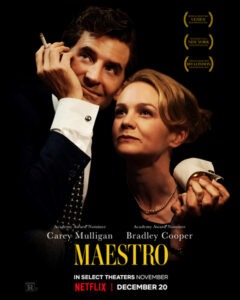 I should begin this Maestro review by telling you the that a personal connection to Leonard Bernstein can’t help but influence my opinion.
My husband’s family has a deep involvement with Tanglewood, the classical music institution that Bernstein loved and supported, and where much of the movie was filmed. Bernstein came to the family home, moved in their circles and conducted many of the concerts they attended. My husband, who studied to be a classical musician, was deeply influenced by Bernstein’s Young People’s Concerts, and played in an orchestra conducted by Bernstein. His name and legend are still hallowed in my in-laws’ home.
So it was with great interest and curiosity that I attended the New York Film Festival premiere of Maestro. What would it reveal about the man so revered by those I love? Would it resinate with their memories and experiences?
In the first five minutes it became apparent that this would not be your typical, candy coated musician biopic, but something much more expansive, compelling and consuming. Bradley Cooper’s Maestro is more than a movie, it’s a cinematic event, lush, rich, inspiring and heartbreaking, often at the same time.
I was astonished by the way Bernstein was portrayed, not as a glorified musical demigod, but as a deeply emotional and passionate genius who made mistakes as well as magic. He is portrayed, warts and all, and it’s sometimes difficult to watch.
Cooper, who co-wrote, produced, directed and starred in the film, worked in close collaboration with Bernstein’s now adult children, Jamie, Alexander, and Nina, whom I chatted with. They told me they watched dailies, and were completely onboard with the project, every step of the way.
They even facilitated filming in their former family home, which had remarkably remained much the same as it was when they grew up there, and they were able to provide some of their mother’s and father’s clothing, which was still hanging in their closets, for costume inspiration.
The much-touted controversy and speculation involving Cooper’s prosthetics and Bernstein’s sexuality are beneath the film. If his family approves of the way their father is portrayed, who are we to object?
Be prepared to see heartrending conflict between wants, needs, and societal expectations that are often at odds with everything Bernstein holds near and dear. Maestro explores Bernstein’s complicated relationship with his wife, Felicia Montealegre, who is rivetingly portrayed by Carey Mulligan. Their conversations, thanks to screenwriters Josh Singer and Cooper (wearing yet another hat) are among the most moving segments of the film. Have your tissues ready.
But also be prepared with those tissues for tears of joy when Cooper, as Bernstein, conducts some of the most radiant music ever composed. My husband says Cooper is a little more demonstrative than Bernstein was when he conducted, but that was his only critique of the film. In my opinion, Cooper’s grand gestures added even more dimension.
This is definitely one of the best films of the year. Cooper is by all means worthy of all the accolades and awards he is sure to receive.
Rated R
2 Hours 9 Minutes
If this Maestro review feeds your need to see it immediately, check Fandango to see if you live in one of the limited markets where it’s been released in theaters. Or wait until it starts streaming, Nov. 20, on Netflix.
Lisa Johnson Mandell’s Maestro review sings the praises of Bradley Cooper’s brilliant efforts to tell the story of Leonard Bernstein, the great conflicted genius. Is there any other kind?

