
LA BOLA NEGRA Review — A Massive Surprize
If you were expecting
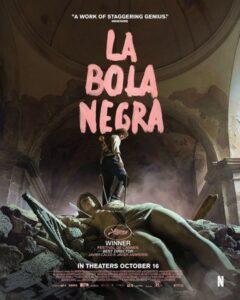 Well color me surprised! I entered my critics screening of La Bola Negra (The Black Ball) with the highest of expectations. It was a critical darling, having won top awards at the most prominent film festivals. Javier Calvo and Javier Ambrossi, the young, fresh, engaging and energetic Spanish writer-director duo, cheekily known as “Los Javis” who created the sweeping epic couldn’t have been more promising.
And the trailer, giving us but a small taste of the glorious visual elements that were to come, was mesmerizing.
Alas, after the first 10 minutes, during which a horrifying occurrence jolted us from our seats and served notice that this was going to be a consummately emotional heart wrencher, the narrative starts knotting and fraying, unraveling into such a tangled (all be it beautiful) mess that the leaves the average filmgoer befuddled and wanting, spending more time trying to figure out “wait, what’s going on?” rather than enjoying the breathtaking imagery and internalizing the messages that are so earnestly and urgently presented.
A little more background, exposition or context of the events explored in the film would have been appreciated, as most non-Spanish viewers are not well versed on the intricacies of the Spanish Civil War and its dominating, homophobic fascists or the works of Spanish poet playwright and theater director Federico García Lorca.
Hey, I spent a couple of the most seminal years of my life in Spain, can speak fluently with both a Castilian and Andalusian accent, am more familiar with the Spanish Civil War than most Americans, and have actually read and discussed some of Lorca’s poetry — in Spanish — and I was confused by the narrative that whiplashes back and forth between three generations and time frames, the years 1932, 1937 and 2017.
Interestingly enough, one of those narratives uses the same device that enraged and confused so many viewers of the film Digger — there’s a distinct theatrical thread being pulled.
Perhaps in an effort to be more universally accessible, well known actors Penélope Cruz and Glenn Close have been cast in a few brief slices of the film that clocks in at more than two-and-a-half hours, but instead they serve as memorable, and somewhat out of place distractions.
Spanish actors including Guitarricadelafuente, Miguel Bernardeau, Milo Quifes and Lola Dueñas give powerful performances, that give the film much needed anchoring.
There are countless dazzling images in the film that reveal Los Javis to be extremely visiual filmmakers. There are moments so poignant they’re sure to wring tears from even the most stoic eyes. If only they could have been woven together in a more accessible fashion — this is a vibrant crazy quilt of a film, with a number of extraordinary patches rather arbitrarily stitched together, rather than a cohesive tapestry whose beauty is apparent to all who behold it.
I find it fascinating that over the last several years, Netflix has chosen three big swing, splashy Spanish language films to promote as Best Picture Academy Awards contenders: Roma, Emilia Perez and now La Bola Negra. Will this be the year Netflix takes the grand prize for its unique ambition?
At this point, La Bola Negra seems to have a lot of momentum, a number of critics claiming it shares a pedestal with The Odyssey.
I am obviously not one of those critics, but I do admire the effort, creativity and skill that went into the creation of La Bola Negra. I just want viewers to know that it may not be their cup of tea, and that confusion, frustration and melancholy could result. Be assured that it isn’t you, it’s them.

